
It sounds like a James Bond movie—No Time to Die—but in reality, the British Parliament has definitively rejected the euthanasia bill, despite the strong Labour majority (which is theoretically “left-wing”). There will be no euthanasia in British hospitals. An initial draft of the bill had been approved by the House of Commons last year, only to be rejected by the House of Lords; it was recently reintroduced by a Labour MP, but many colleagues who had initially voted for it changed their minds. They reported feeling sick, having nightmares, and being unable to sleep at night after voting in favor of euthanasia last year, so they voted against it this time around, effectively killing the bill. Other MPs abstained, while some commentators voiced fears of an “abortion effect”—the idea that “you legalize it for extreme cases, and then hospitals end up performing it constantly, as if it were no big deal.” Attention was also drawn—as it was in Italy and the rest of Europe and the world—to the Spanish case of a 22-year-old woman who, suffering from depression following a rape (or gang rape—I don’t recall the details) no longer wished to live and got euthanised, as well as notorious cases in the Netherlands where it turned out the deceased had not actually given their consent. The bill failed to pass in England and Wales, and it is said that the issue will not be raised again for a generation. I personally think this is very good news.
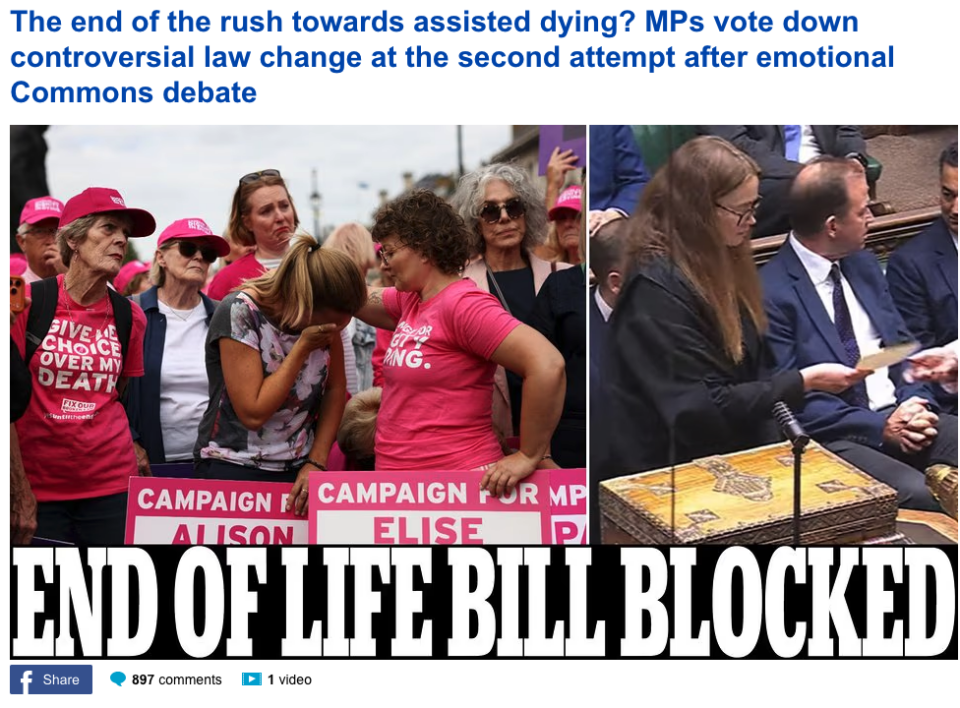
By GREG HEFFER, POLITICAL CORRESPONDENT Published: 14:45 BST, 11 September 2026
A fresh bid to legalise assisted dying was defeated in the House of Commons today as efforts to revive a controversial Bill fell at the first major hurdle.
MPs voted by 286 to 270, majority 16, to reject the Terminally Ill Adults (End of Life) Bill at its Second Reading.
There were cheers and a shout of ‘good’ as the result was announced in the chamber, while some MPs could be seen hugging and pumping their fists as the Bill fell.
It followed a passionate four-and-a-half hour debate in the Commons on Friday between supporters and opponents of assisted dying.
Many MPs spoke emotionally about their own personal experiences and the experiences of their dying loved ones.
The Bill had aimed to allow terminally ill adults in England and Wales with fewer than six months to live to apply for an assisted death.
It had been reintroduced by Labour MP Lauren Edwards despite its failure in the last parliamentary session when – although it passed two votes in the Commons – it fell in the Lords.

MPs voted by 286 to 270, majority 16, to reject the Terminally Ill Adults (End of Life) Bill at its Second Reading
The Bill was rejected on Friday after a number of MPs abandoned their previous support for the legislation to vote against it this time round.
They included Labour former minister Janet Daby, who revealed she had ‘nightmares about dying and death’ after she voted in favour of the Bill last year.
‘I had to wrestle with myself, knowing that I was not entirely comfortable with the decision I had made, and my conscience was not at peace, and I cannot again, in good conscience, vote for the Bill,’ she told the Commons on Friday afternoon.
Prime Minister Andy Burnham and Reform UK leader Nigel Farage did not vote on Friday, while Conservative leader Kemi Badenoch and Liberal Democrat leader Ed Davey both voted against the Bill.
Campaigners welcomed the fall of the Bill and claimed the Commons defeat meant the issue of assisted dying had been settled ‘for a generation’.
Ms Edwards had re-introduced the Bill to the Commons after taking over from its previous sponsor, Kim Leadbeater.
During Friday’s debate, she urged her fellow MPs to send the near-identical Bill back to the Lords ‘so that they can finish what they started’ in scrutinising the legislation.
But critics argued the ‘flawed’ Bill is ‘unsafe’ and told the Commons not to return it to the Lords unamended.
Mrs Badenoch warned against trying to ‘ram’ through the ‘badly drafted’ legislation.
‘It’s rushed, it’s badly drafted – and I say this as someone who is not, in principle, opposed to assisted suicide,’ the Tory leader said. ‘I think we need to be very careful about what we’re doing.
‘I don’t think our NHS is ready and I think this should be something that the Government does thoughtfully, not a private members’ Bill, let alone one which has failed before and which they’re trying to ram through with government numbers.
‘I think that’s wrong.’
Ms Edwards on Friday said MPs were being asked to consider ‘who ultimately decides the laws that govern our nations’ after the unelected Lords blocked the Bill last time round.
Opening the Second Reading debate, she said: ‘We can and we must improve both palliative care and support assisted dying.
‘We must grasp that opportunity in front of us to create a holistic end of life care system that will deliver choice and dignity for every single one of our constituents.’
She said that, because of the four-year implementation period in the Bill, assisted dying would not be available across the two nations until 2031 at the earliest.
‘We owe it to the people that we represent to find a resolution to this issue, one way or the other, within this Parliament,’ the Labour MP for Rochester and Strood added.
Dame Karen Bradley, a Conservative former minister, said previous supporters of the Bill should feel ‘no shame’ in opposing the draft new law.
‘You do not have to repudiate the vote you cast last time in order to vote differently today,’ she said.
‘You do not have to decide that assisted dying can never be right. You do not have to abandon the compassion that led you to support the principle.
‘You need only ask whether this Bill, in this form, on the evidence before us now today, is safe enough for Parliament to force into law.
‘That is today’s test and there is no shame whatsoever in concluding that the answer to a different question is different, indeed, there will be something profoundly wrong with a Parliament in which members felt bound by an earlier vote, regardless of everything they’d learned since.’
Dr Zubir Ahmed, a cancer surgeon and former health minister, told the Commons that the social and palliative care system ‘simply is not ready’ for assisted dying, adding that there can often be uncertainty in a doctor’s prognosis for terminally ill patients.
He told the chamber: ‘I have to be honest with you. When I am asked to prognosticate as to whether someone has six months to live or not, I am as often wrong as I am right.’
Ashley Dalton, another Labour former health minister, told the Commons that she herself has stage four metastatic breast cancer, which is incurable.
She said her cancer ‘is stable’ but warned she was unsure for how long drugs would continue to work.
Ms Dalton said: ‘Palliative care professionals and oncologists tell me that, whilst they can more or less give me an indication of when I’ll die when I’m a few days or weeks off, anything beyond that is the flip of a coin.
‘The six-month prognosis in this Bill is something no one can ever be really sure of.’
(………………………………….)
Following Friday’s vote in the Commons, Ms Dalton and fellow Labour MPs Meg Hillier and Jess Asato, who also voted against the Bill, said: ‘MPs have voted against this Bill because it wasn’t an abstract debate but a decision about a real Bill that was unsafe and unworkable.
‘But this is not a moment for celebration, we understand the deep concerns of so many people across the country who have campaigned hard for a change in the law.
‘But the truth is none of the relevant royal medical colleges, professional groups or experts will attest to the safety or workability of this Bill.
‘The PM is right; we must fix our NHS and sort out social and palliative care before we even consider introducing assisted dying.’
(……………………………………….)
Alisdair Hungerford-Morgan – chief executive of Right To Life UK, a charity that opposes the introduction of assisted dying – said: ‘This is a remarkable victory for the most vulnerable in our society.
‘They deserve protection and care, not a pathway to suicide.
‘After a two-year-long national debate, the country has decided to reject assisted suicide, settling the issue for a generation.
‘Evidence from overseas shows that, had this legislation become law, countless vulnerable people nearing the end of life would have been pressured or coerced into ending their lives.’